

.jpg)
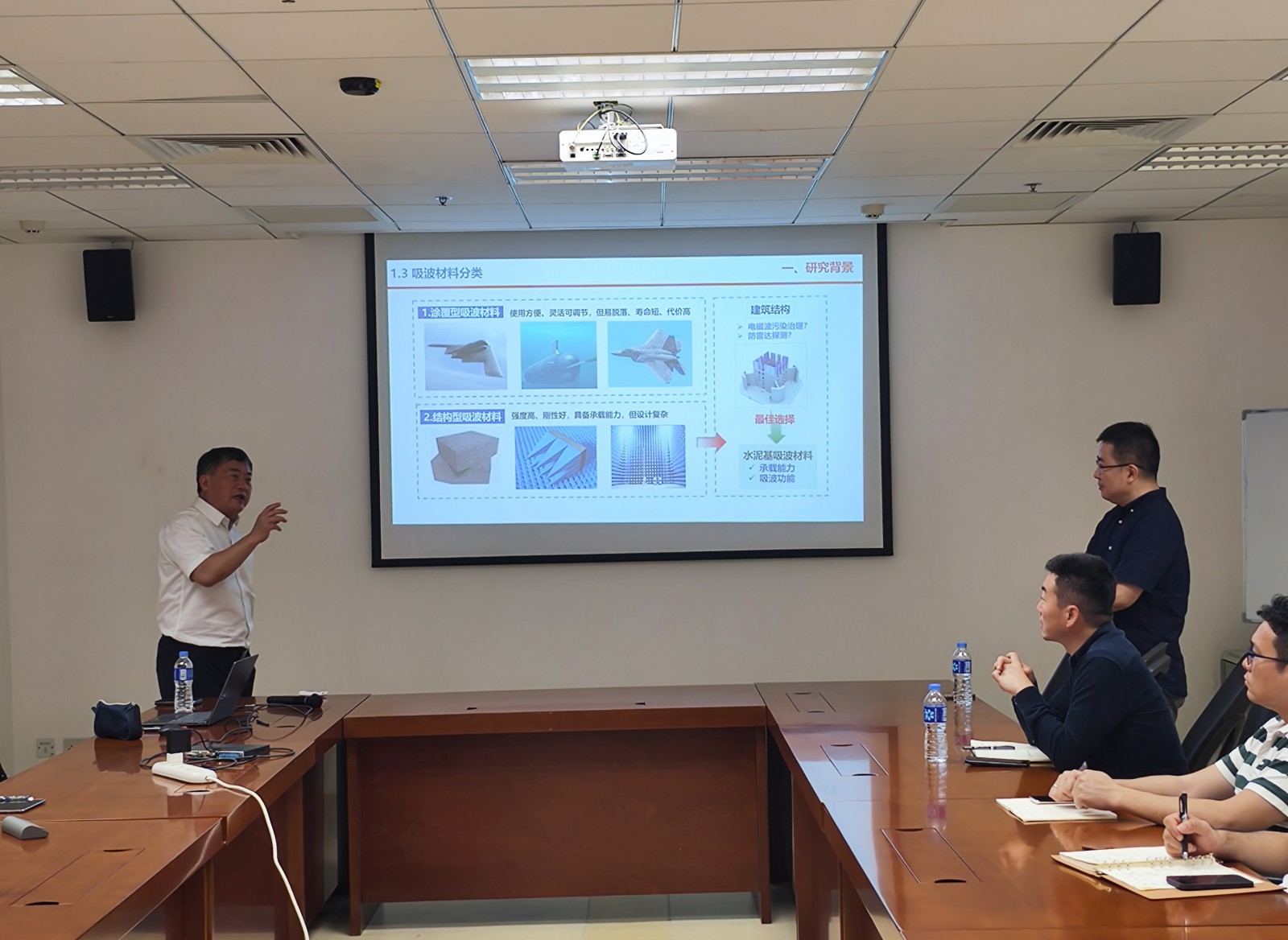
Expert: Prof.QiJun YU
Title: Broadband and modifiable electromagnetic wave absorbing cement-based materials
Expert's Profile: Prof. Qijun Yu is a Professor and Doctoral Supervisor at School of Materials Science and Engineering in South China University of Technology. He is an expert having special government allowances of the State Council. He is Pearl River Scholar in Guangdong Province, and also serves as a member of Teaching Steering Committee for Materials Disciplines under the Ministry of Education, Standing Director of Chinese Ceramic Society, Honorary President of Guangdong Provincial Ceramic Society.
Main Research Areas and Achievements: Professor Qijun Yu has long been engaged in fundamental research, technological development, and application of low-carbon, high-performance cement-based materials. Focusing on key issues such as the preparation of green and low-carbon cement, resource utilization of solid waste, and environmental impact of building materials, he has successively completed over 50 projects, including National Key Research and Development Program of China, National Key Technology R&D Program, National "973" and "863" Programs, key projects of National Natural Science Foundation of China, as well as projects commissioned by enterprises and institutions. The technologies he developed, such as green and low-carbon blended cement preparation technology and flue gas desulfurization and denitrification technology for cement kilns, have been widely promoted and applied, achieving significant social and economic benefits. Professor Yu has won 3 first prizes and 4 second prizes of provincial/ministerial-level Science and Technology Progress Awards. He holds over 60 authorized patents and has published more than 400 papers in journals including Cement and Concrete Research, Corrosion Science, Cement and Concrete Composites, and Composites Part B. He has also edited or co-edited multiple standards, making significant contributions to the progress of the industry.
Abstract: With the advancement of radar detection technologies, the protection and concealment of engineering structures have become increasingly challenging. Based on the principle of radar detection, it is imperative to conduct research on new cement-based electromagnetic wave-absorbing materials(EWAM) and their environmental compatibility. Currently, existing cement-based composites suffer from issues such as narrow absorption bandwidth, lack of dynamic regulation of wave-absorbing performance, and poor environmental compatibility. In this study, a design method for EWAM based on structural design and component optimization is proposed, and wedge-shaped EWAM with strong absorbing performance are successfully prepared, with effective bandwidths of 15.2 GHz (< -10 dB) and 12.9 GHz (< -20 dB), and an average reflectivity of -27.1 dB. By fabricating magnetofluid tubes and magnetofluid capsules, dynamically modifiable EWAM with flat structures, laminated structures, porous structures, and wedge structures are developed. Dynamic regulation of the minimum reflectivity, average reflectivity, and effective absorption bandwidths has been achieved. In addition, an evaluation method for the compatibility between EWAM and environmental wave-absorbing performance is proposed, and EWAM matching desert and grassland environments are successfully prepared. The development of EWAM with broadband and modifiable wave-absorbing properties is of great significance for mitigating electromagnetic radiation pollution, enhancing the protective capacity of buildings, and safeguarding national and people's lives and property.
Thanks to prof. Qijun YU for the wonderful Seminar!