

Research Direction Summary:
The research group focuses on the study of organic/inorganic composite materials.
(i) Modification of inorganic cement-based composite materials using organic polymers, nanoparticles, composite foams, etc.;
(ii) Modification of organic polymer-based composite materials using nanoparticles generated from inorganic cement or other functional components.
Keywords:cement, polymer, nanocomposite, hydrogel, foam concrete
Research Content and Technical Route:
1) By slowly releasing 3-5 nanometer calcium hydroxide crystals from cement in cold water, the size and dispersion of the nanoparticles are controlled and then composited with polymers. This results in the preparation of a series of high-performance hydrogel materials with superelasticity, sensing, pigment adsorption, and water absorption properties.
2) Nanoparticles are used to stabilize the outer wall of bubbles to form nanoparticle-stabilized foam, which is then mixed with cement paste and other cementitious materials to prepare nanofoam concrete.

Research Achievements:
1) Cement is placed in zero-degree cold water, slowly releasing 3-5 nanometer calcium hydroxide nanospherulites (CNS). These slowly released nanoparticles, which then polymerize in situ with various water-soluble monomers to form a series of high-performance nanocomposite hydrogels. When compounded with 40-200 ppm of CNS, polyacrylamide gels exhibit superelasticity, instantly returning to their original shape after being stretched 120 times or subjected to a pressure of 220 MPa. Polyacrylic acid salt gels exhibit superabsorbency, capable of absorbing methyl blue pigment four times their own weight. Polyacrylic acid salt/benzenesulfonate copolymers exhibit superabsorbency, swelling to 13,600 times their own weight in water.
2) Superabsorbent resins made with CNS expand 2-4 times in salt water compared to relevant commercial products. When added to soil, they can retain 40% of its moisture content for up to six months without loss. Their application in agricultural fields significantly improves plant germination survival rates and root growth. When added to concrete, they act as an internal curing agent, significantly mitigating cracking. Compared to conventional commercial internal curing agents, they reduce strength loss by 50% and increase crack resistance and shrinkage reduction by 3-4 times.
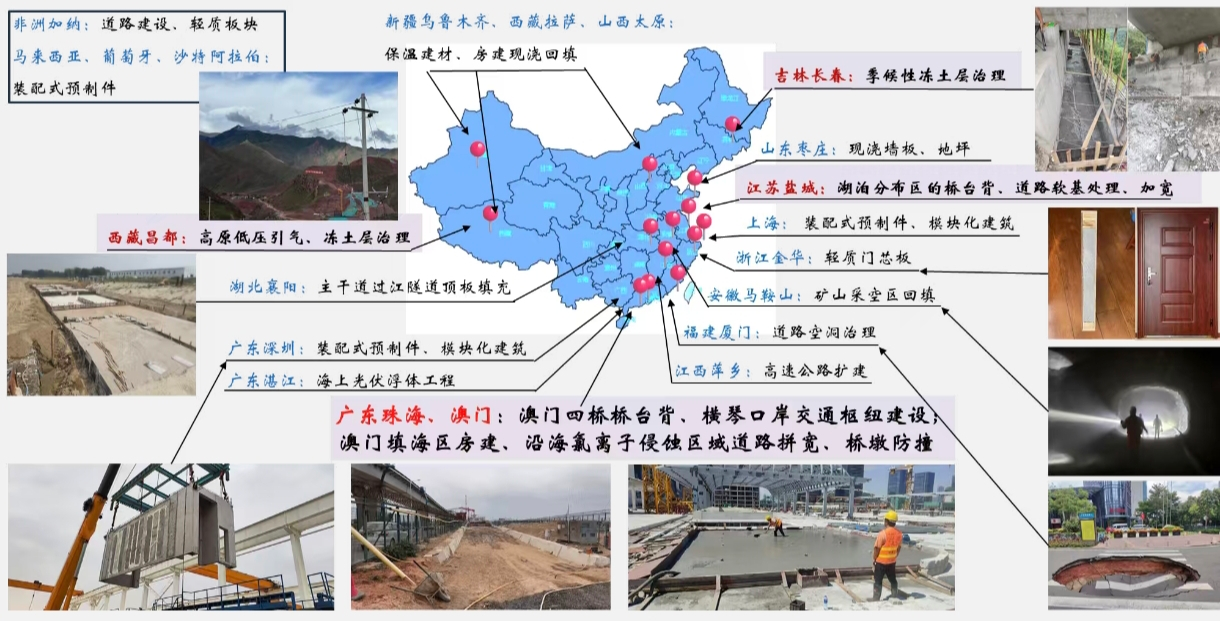
3) By modifying the surface of nanoparticles, they aggregate around the periphery of bubbles, creating a foam-stabilizing effect. The resulting powdered "nanofoaming agent" boasts a volume expansion ratio exceeding 9,000 times, 10-15 times that of commercial concentrated liquid foaming agents. The resulting "nanoparticle-stabilized foam," when mixed with cement, fly ash, slag, and other materials and cured, forms "nanofoam concrete," which far outperforms commercial foam concrete with the same slurry formula. At the same density, the strength is increased by 2-5 times; while maintaining the same strength, the raw materials used can be reduced or the density can be lowered by 15-40%. It has been widely used in large-scale housing and transportation construction projects in 15 cities, including China's largest land customs clearance port, the Zhuhai-Macau Hengqin Port Integrated Transportation Hub (100,000 square meters), the Xiangyang Cross-River Tunnel roof (30,000 cubic meters), and multiple approach bridges of the Macau Bridge.
Application Examples:
Representative Papers/Patents:
Yasen Li, Cheng Zhang*, Yangyang Xiang, Yanru Chen, Tingzhong Li, Honghai Cui, Guoxing Sun*. Microstructure tailoring of internal curing agents: modified cement particles/superabsorbent polymers composites balancing strength and shrinkage mitigation. Cement and Concrete Research. 197, 2025, 107950.(IF: 13.079)
Tingzhong Li, Tongyuan Liu, Qinglu Yu, Yasen Li, Rui Liang*, Guoxing Sun*. Stretching-Orientation Reinforced Double Network Solvent-Free Eutectic Gels for Ultrarobust, Flexible Human-Machine Interaction Devices. Advanced Functional Materials. 2025, 2508233. (IF: 18.173)
Rui Liang, Qing Liu, Dongshuai Hou*, Zongjin Li and Guoxing Sun*.Flexural strength enhancement of cement paste through monomer incorporation and in situ bond formation. Cement and Concrete Research. 2022, 152, 106675.(IF: 13.079)
Lirong Liang, Miaomiao Wang, Xiaodong Wang, Peng Peng, Zhuoxin Liu*, Guangming Chen* and Guoxing Sun*. Initiating a Stretchable, Compressible, and Wearable Thermoelectric Generator by a Spiral Architecture with Ternary Nanocomposites for Efficient Heat Harvesting. Advanced Functional Materials. 2021, 2111435. (IF: 18.173)
Lirong Liang, Haicai Lv, Xiao-Lei Shi, Zhuoxin Liu*, Guangming Chen*, Zhi-Gang Chen* and Guoxing Sun*. A flexible quasi-solid-state thermoelectrochemical cell with high stretchability as an energy-autonomous strain sensor. Materials Horizons. 2021, 8, 2750-2760. (IF: 10.719)
Guoxing Sun, Zongjin Li*, Rui Liang, Lu-Tao Weng, and Lina Zhang. Super stretchable hydrogel achieved by non-aggregated spherulites with diameters < 5 nm. Nature Communications. 2016, 7, 12095. (IF: 15.62)